Celestial Matters, part 1

Celestial Matters, part 1: Time and Calendar

Devanand has a solar year of 368 days.  On Bhaskara, this is divided into 13 months of 28 days, with four “extra” days, called the Days of Transition.  These days are filled with magic and celebration.  Well, in some places.  In other places they’re filled with fear and quiet contemplation.  It all depends on your dragon overlord.

I’ve included a calendar from the hills of Mahday, and you can read the full write-up here: Time and Calendar

Creative Commons License This work by Jean Headley is licensed under a Creative Commons Attribution-NonCommercial-NoDerivatives 4.0 International License.

Mira

This week’s blog is a second character sketch: Mira, a young healer at the Temple of the Moon.  Mira’s going places, destined for great things, if jealousy within the Temple doesn’t kill her.  In game terms, Mira has above average Intelligence and Charisma scores, a high Wisdom score, and average physical attributes.  She has not yet developed any real leadership qualities, but that will come with time and training.

You can read the full write-up here: Mira

I’d like to hear what you think, and what you’d like to see.  Any comments, suggestions, or questions are welcome.  Enjoy!

Creative Commons License This work by Jean Headley is licensed under a Creative Commons Attribution-NonCommercial-NoDerivatives 4.0 International License.

Dirty Sal

I thought this week I’d start to introduce you to some of the people of Kerani.  I started with Dirty Sal, a shopkeeper, fence, and former thief.  He was my primary NPC when I started running this campaign for my daughter.   Using the D&D 3.5 rules, Sal would be classed as a Rogue.

You can read more about Dirty Sal here.

Creative Commons License This work by Jean Headley is licensed under a Creative Commons Attribution-NonCommercial-NoDerivatives 4.0 International License.

The Sacred Dreamers

This week’s post gives an overview of the most elite group of people in Devanand: the Sacred Dreamers of Kerani.

Prophets both blessed and cursed, they are a powerful force in the city, giving Bhanu forewarning of disasters, calamities, and attacks.

You can read the whole post here: The Sacred Dreamers

Creative Commons License This work by Jean Headley is licensed under a Creative Commons Attribution-NonCommercial-NoDerivatives 4.0 International License.

The Red Sash

This week’s post is short, but deals with Kerani’s criminal element.  The Red Sash is a “guild” of thieves, assassins, and cutthroats, preying on the citizens of Kerani.

The featured image is part of a sketch of Kerani.

You can read the full post here: The Red Sash

Creative Commons License This work by Jean Headley is licensed under a Creative Commons Attribution-NonCommercial-NoDerivatives 4.0 International License.

Lalika

This week I decided to focus on the neighbors.  First up is Lalika, under the rule of the green dragon Janesh.  Lalika and Jarayu are usually at odds with each other because Janesh and Bhanu are bitter enemies.

You can read the full description here: Lalika.

A friend of mine recommended that I include pronunciation guides, and meanings for names where appropriate.  I found, while writing the piece on Lalika, that I had to be careful not to clutter the page with these.  So I’ll include some of this information where I can do so without disrupting the flow of the writing.  🙂

I hope you enjoy the write-up on Lalika!

If you have any questions, comments, or suggestions, I’d love to hear from you.

~Jean

Creative Commons LicenseThis work by Jean Headley is licensed under a Creative Commons Attribution-NonCommercial-NoDerivatives 4.0 International License.

More about Dragons

I am having SO much trouble getting the menus just right.  Please bear with me.

I decided this week to add brief bios on two other dragons: the Mother of Devidhyaan, and the Master of Lalika.

The Mother is an ally, friend, and sometimes mate of Bhanu’s.  Janesh, Master of Lalika, is their bitterest enemy, responsible for the deaths of both their mothers.

You can read more about Mother here.

And more about Janesh Lalika here.

The dynamic between these three individuals drives much of the political scene on the continent.

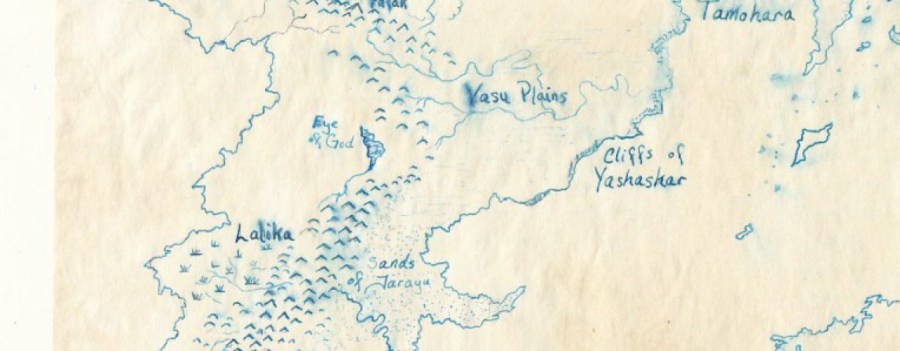
This week’s featured image shows Devidhyaan, which means “Eye of God”, Lalika, and the west of Jarayu.

Devidhyaan-Lalika

Creative Commons License This work by Jean Headley is licensed under a Creative Commons Attribution-NonCommercial-NoDerivatives 4.0 International License.

Dragons and Drakes

I wanted to take a little time to highlight the dragons and drakes of Devanand, with particular attention to Bhanu, the Lord of Jarayu.  I hope you enjoy them both.  🙂

Dragons and Drakes

Bhanu

Also, my lovely daughter Jessica Headley has provided the picture of Bhanu.  You can see her artwork here: http://aria-siaosi.deviantart.com/

Kerani

I was really hoping to have a map to go along with this week’s blog but that didn’t happen.  I do have a short short story instead.

This week was all about Kerani, the capital city of Jarayu.   The city was founded by Bhanu over 200 years ago after his birth city, Aadi, sank beneath the desert sands.  The Lord of Jarayu has spent much time and effort building his city and its people, and this is why Kerani is known as the Jewel of the Desert, and the City of Music.

You can read the full blog here.

And read the companion short story, To Bury the Earth.

Creative Commons License This work by Jean Headley is licensed under a Creative Commons Attribution-NonCommercial-NoDerivatives 4.0 International License.

Jarayu

This week we’re looking at the desert called the Sands of Jarayu because, you know, he owned them. 🙂

Jarayu

(pronounced Ja RI yoo)

Jarayu was named for the first of the great desert dragons. After claiming a region no one else wanted, he took the desert elves under his wings, taught them basic magics, and treated them as valuable resources to be developed. When humans moved into the area from the plains to the north, he offered them sanctuary but only under the condition they maintain a peaceful relationship with his elves. Bhanu, the current lord of Jarayu, is his direct descendent.

The desert of Jarayu lies in the rain shadow of the southern mountain range. It is bordered on the north by the Vasu plains, by the mountains in the west, by the ocean to the east, and by forest to the south. The southern part of Jarayu gradually transforms from desert hills to scrub land. Bhanu is attempting to claim the forest to the south as his own.

The elves call themselves the Lanikamali’i – which means Sky Children. They are nomadic, living in small family groups of 20-30 adults plus children. Every few years the families will gather, exchange news, and part ways again, often in new groupings. They will raid the Vasu plains and the mountains to supplement the goods they can trade for. A few individuals have settled in the small fishing villages that humans founded along the coast. The Lanikamali’i have adapted completely to their desert life. They are tall, for elves, and very thin. They have pale skin and hair that matches the desert sands, and sky blue eyes. This has led some humans to believe, erroneously, that the desert elves are part desert dragon. The Lanikamali’i have developed strong, specialized magic. They craft magical boots and clothes that augment their natural abilities, making them nearly impossible to detect, track, or capture. They use non-magical versions of their cloaks and boots as trade goods. On rare occasion, one may find magical versions for sale in the bazaars of Kerani and Nishad.

The greatest threat to the Lanikamali’i are the giant sand snakes. These snakes are also adapted perfectly to their environment. They are large enough to consume elves and humans, and will do so if given the opportunity. However, they usually prey on other snakes. All of Jarayu’s snakes – which are legless, wingless dragon-kin – have shovel-shaped snouts that let them burrow into sand and loose soil. The smallest of them prey on insects, scorpions, lizards, and other small desert creatures. Some are active hunters while others are ambush predators. Many of them, including the giants, use a sticky secretion to build and maintain tunnels and dens under the sand. The skins of these snakes are waterproof and very durable, and are used by the Lanikamali’i in lieu of leather.

In D&D terms, the elvish boots and cloaks give bonuses to sneak and hide. These bonuses are higher in the desert than elsewhere, but it’s magic so they work in any environment.

Check back next week, when we take a look at the Jewel of the Desert – the city of Kerani

Creative Commons License This work by Jean Headley is licensed under a Creative Commons Attribution-NonCommercial-NoDerivatives 4.0 International License.